
Choosing Ingredients
Starters
The starter is the key to fermenting milk; it must be ‘active’ (capable of getting fermentation going) and well mixed in the milk (‘dispersed’) by gentle stirring.
There are several ways of starting fermentation:
1. A spoonful or two of live plant yoghurt

Add a batch of milk into the bowl, then gently stir in a teaspoon or two of live yoghurt per half litre of milk (this must made from the same kind (eg soya yogurt for soya milk).
2. Sachets of proboiotic

These are available online and at some stores. Each sachet comes with a ‘use by’ or expiry date (though this is no guarantee the contents will be active). The full sachet should be used, rather than saving some for a later fermentation, as the ability to start fermentation decreases with age.
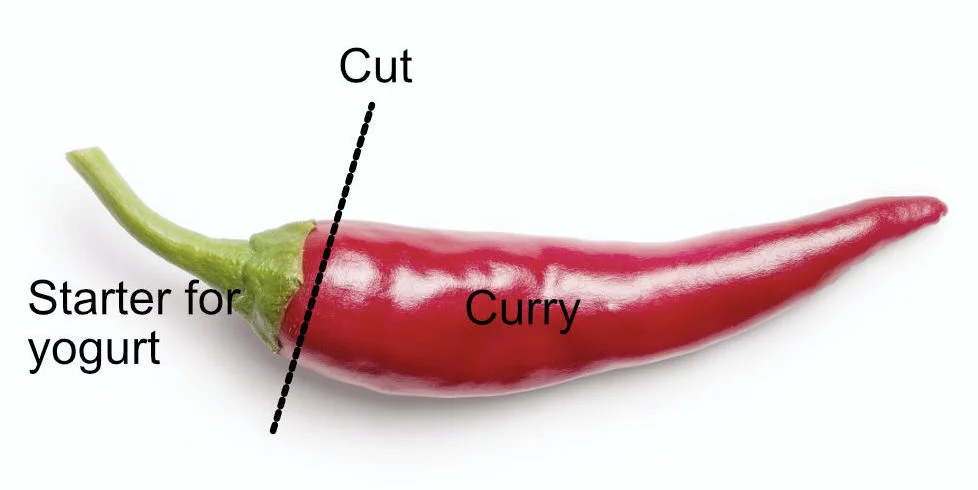
3. Chilli Tops
Starters
The tops of several chilli peppers (red or green) will start fermentation in any kind of milk. After a couple of days in a warm cupboard, the milk will have fermented and the chilli tops are then disposed of. The remainder of the chilli can be used in cooking.
Unlike the other methods, so long as the chilis are fresh, there is no expiry date.
Value for money
The cheapest and most common way of starting fermentation is probably the first method – adding a little live culture in order to ‘start’ the milk.
More important than anything however, is being sure that the starter you choose is active – inactive starters can allow contamination from airborne bacteria.
Check your starter
Age makes a huge difference to the quality of starter culture; probiotic sachets and capsules have a ‘use by’ date, which must be checked, and milk must be fresh. If in any doubt, test your starter on a small sample of soya milk; if there is no curd and whey after two days in a warm environment, try a different starter.
Live culture should be rejected if more than 7 days old, as it may not start fermentation.
Choosing a variety of plant milk
Fortunately, there are only two ingredients, milk and your chosen starter, but it is important to choose an organic and additive-free (natural) variety.
By the same principle, cheesecloth used for straining yogurt should also be organic.
